

How to Compare Remodeling Estimates: Why Quotes Differ by Thousands
 Picture three hypothetical estimates spread across your kitchen table. One says $38,000, one says $44,500, one says $52,000. All three contractors walked the same room, nodded at the same wish list, and promised the same finished kitchen. So why is there a $14,000 gap, and which number should you trust?
Most homeowners do one of two things. They pick the lowest price and hope for the best, or they pick the middle one because it feels safe. Both approaches skip the real question: are these three quotes actually pricing the same project? Usually they aren’t. This guide explains why remodeling quotes differ by thousands, how to put them side by side honestly, and what Michigan’s consumer protection rules say about the paperwork around the price.
Why Price Alone Tells You Almost Nothing
The variation is real, and it isn’t unique to Michigan. Consumers’ Checkbook, a nonprofit that sends undercover shoppers to collect bids, asked contractors in the Chicago area to price identical jobs. A standard bathroom remodel came back anywhere from $8,500 to $13,250, and the largest job, a two-story addition, ranged from $190,000 to $321,000.[1] That’s a spread of more than $130,000 for the same plans. The same article adds something worth sitting with: in Checkbook’s experience collecting prices across many trades, there’s no relationship between how much a company charges and how good its work is.
That cuts both ways. A high quote doesn’t prove quality, and a low quote doesn’t prove a bargain. The number only becomes meaningful once you know what’s inside it.
Estimate, Quote, Bid: Know What You’re Holding
The words get used loosely, so start by asking. An estimate is generally an approximation based on limited information, while a quote is an offer to do a defined job for a fixed price.[2] Bids and proposals sit somewhere in between, depending on who’s talking. One remodeler’s glossary puts the practical advice plainly: never assume a number is a firm price, and ask whether it’s an estimate or a fixed bid and what conditions apply.[3]
Even a fixed price usually comes with a safety valve. Checkbook notes that most contracts include provisions for extra charges if something unexpected turns up, such as inadequate insulation behind walls or rotten sheathing, and that extra work is typically billed as time and materials.[1] That isn’t a trick, because old Michigan houses do hide surprises. But it means two fixed prices can behave very differently once demolition begins, depending on how each contractor handles the unknowns. Ask every bidder how they’d price something unexpected before you sign anything.
Where the Gap Between Quotes Actually Comes From
When two estimates for the same remodel differ by thousands, the difference almost always traces back to a handful of causes.
Scope and exclusions. One contractor includes demolition, dumpster, permits, electrical updates, drywall repair, and final cleaning. Another leaves some of those out, sometimes because they’re genuinely not needed, sometimes because they were forgotten. Permits, appliances, landscaping, utility connection fees, and final cleaning are common exclusions,[4] and the exclusions list is often where a cheap quote hides its savings.
Allowances. If your plans don’t specify every faucet and tile, contractors fill the gaps with allowances, which are placeholder budgets for products you’ll choose later. This is one of the biggest sources of misleading comparisons. BuildZoom offers a clean example: a contractor who includes $2,000 for tile is not the same as one who includes $7,500, even if their totals look close.[4] A low allowance makes the bid look cheaper today and sends you a bill later when your real selections cost more. Warning signs include allowances that are unrealistically low, such as $1,000 for all the lighting in a kitchen.[5]
Materials and products. Two cabinets can both be called “shaker style” and differ enormously in construction. Quartz thickness, tile grade, fixture brands, and window quality all move the price. Checkbook also points out that most remodelers mark up the products they buy, sometimes by a lot,[1] so it’s worth checking retail prices on big-ticket items you could source yourself.
Doing it by the book. A contractor who carries a Michigan license, proper insurance, and pulls permits has costs that a corner-cutting competitor doesn’t. In Rochester Hills, for example, residential contractors must register with the city’s Building Department before applying for a permit,[6] and plan review and permit fees are part of the real cost of a compliant project.
Overhead and profit. It’s natural to wonder how much of a quote is simply profit. The industry data suggests it’s less than most people assume. The National Association of Home Builders reports that the average net profit margin for remodelers was 6.3 percent in 2024, the highest since 1996,[7] with gross margins averaging 29.9 percent.[8] Gross margin has to cover the office, vehicles, insurance, warranty work, and owner pay before anything is left over. A contractor who’s $14,000 cheaper isn’t usually accepting a smaller profit. They’re more often pricing a smaller scope, lower allowances, a thinner crew, or more risk.
Unknowns and risk. Some contractors carry a contingency for surprises. Others price the best case and expect change orders to fill the gap. Houzz’s 2026 study found that 37 percent of renovating homeowners went over budget, and among them, 52 percent cited unexpected product or service costs while 22 percent discovered construction-related issues once work was underway.[9] Neither approach is dishonest. They just produce very different final bills.

A Hypothetical: The $14,000 Gap That Mostly Disappears
Here’s how this plays out in practice. The numbers below are invented to show the method, not real pricing, but the pattern is one you’ll recognize.
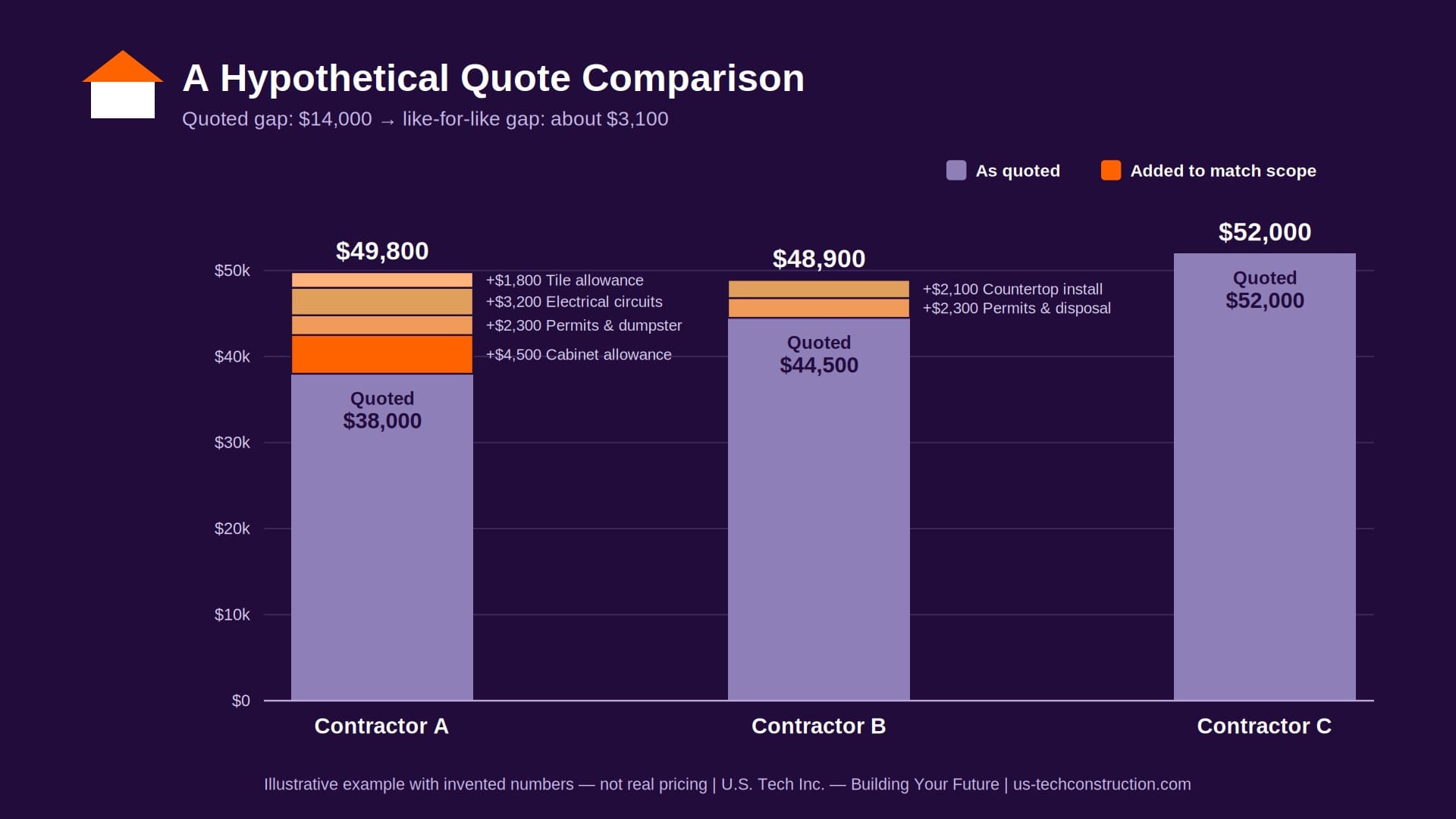
Suppose your three kitchen quotes are $38,000 (Contractor A), $44,500 (Contractor B), and $52,000 (Contractor C). On the surface, A looks like a $14,000 bargain. Then you ask each one to list exclusions and allowances, and the picture shifts.
Contractor A’s quote carries a cabinet allowance $4,500 lower than the others, excludes permit fees and dumpster rental ($2,300), leaves out the electrical circuit work your new appliances need ($3,200), and budgets $1,800 less for tile. Add those back at what the other bids assume, and A’s real number is about $49,800. Contractor B’s quote is closer, but it excludes permits and disposal ($2,300) and countertop templating and install ($2,100), which brings B to roughly $48,900. Contractor C already included everything at $52,000.
The gap just shrank from $14,000 to about $3,100, and now you can have a different conversation. The question is no longer “why is C so expensive?” It’s “what do I get for roughly $3,000 more: a different crew, a better warranty, a faster schedule, a contractor I trust more?” That’s a decision you can actually make.
How to Compare Estimates Line by Line
You don’t need special software, just a notepad or spreadsheet and a willingness to ask questions.
Start with the same scope. The fairest comparisons begin when every contractor prices the same drawings, the same layout, and the same product selections. The more you specify up front, the fewer allowances you’ll see. BuildZoom makes the point well: the number of bids matters less than the quality of what you’re comparing, because three bids built on detailed scopes are meaningful and three built on assumptions are not.[4]
Build a side-by-side sheet. Make a row for each major item: demolition and disposal, framing, plumbing, electrical, drywall and paint, cabinets, countertops, flooring, tile, fixtures, appliances, permits, cleanup. Fill in each contractor’s figure or note “not included.” Blank cells are where the surprises live.
Normalize the allowances. Where a contractor lists an allowance, write down the dollar amount and ask what it covers, including labor, and what happens if your selection costs more or less. Then price your actual selections at a showroom so you know which allowances are realistic.
Ask the three questions that expose the most. What’s not included in this price? What happens if you find something unexpected behind the walls? And how are change orders priced and approved? A thoughtful contractor will answer these without defensiveness. A vague answer tells you something too.
Compare the non-price terms. Look at the start and completion dates, the warranty, who’s responsible for cleanup and permits, and whether the schedule is realistic for the lead times involved. We covered how those timelines work in our guide to how long home remodeling projects really take in Michigan.
Check Who’s Behind the Number
The cleanest quote in the world is only as good as the company standing behind it. Michigan’s Attorney General recommends seeking two or three written estimates and carefully comparing the services and materials with the price,[10] and checking the contractor’s license, insurance, references, and complaint history before you sign.
On licensing, Michigan generally requires residential builders and maintenance and alteration contractors to hold a state license,[11] and you can verify one through the Michigan Department of Licensing and Regulatory Affairs. The Attorney General’s guidance suggests searching by license number as well as the company name. It also offers a useful warning about insurance: when a contractor says they’re insured, the typical coverage relates to injuries on the job, so ask “insured, for what?”[10] A certificate of insurance showing general liability and workers’ compensation is a reasonable thing to request.
References matter too. The same guidance advises asking for a list of homeowners who hired the contractor for similar projects and calling them before you sign, and checking complaint histories with the Better Business Bureau and the Attorney General’s Consumer Protection Team. Ask those references what the final bill looked like compared with the original quote, and how the contractor handled surprises. Their answers tell you more than any brochure.
One more red flag from the same guidance: be wary if a contractor asks you to pull the building permit yourself. The Attorney General notes that such a request can signal a contractor who isn’t licensed or isn’t welcome at the local building department. If you want help vetting a company beyond the paperwork, our posts on how to choose a home remodeler in Rochester Hills, ten questions to ask before you renovate, and red flags to avoid when hiring go deeper.
Read the Payment Terms Before the Price
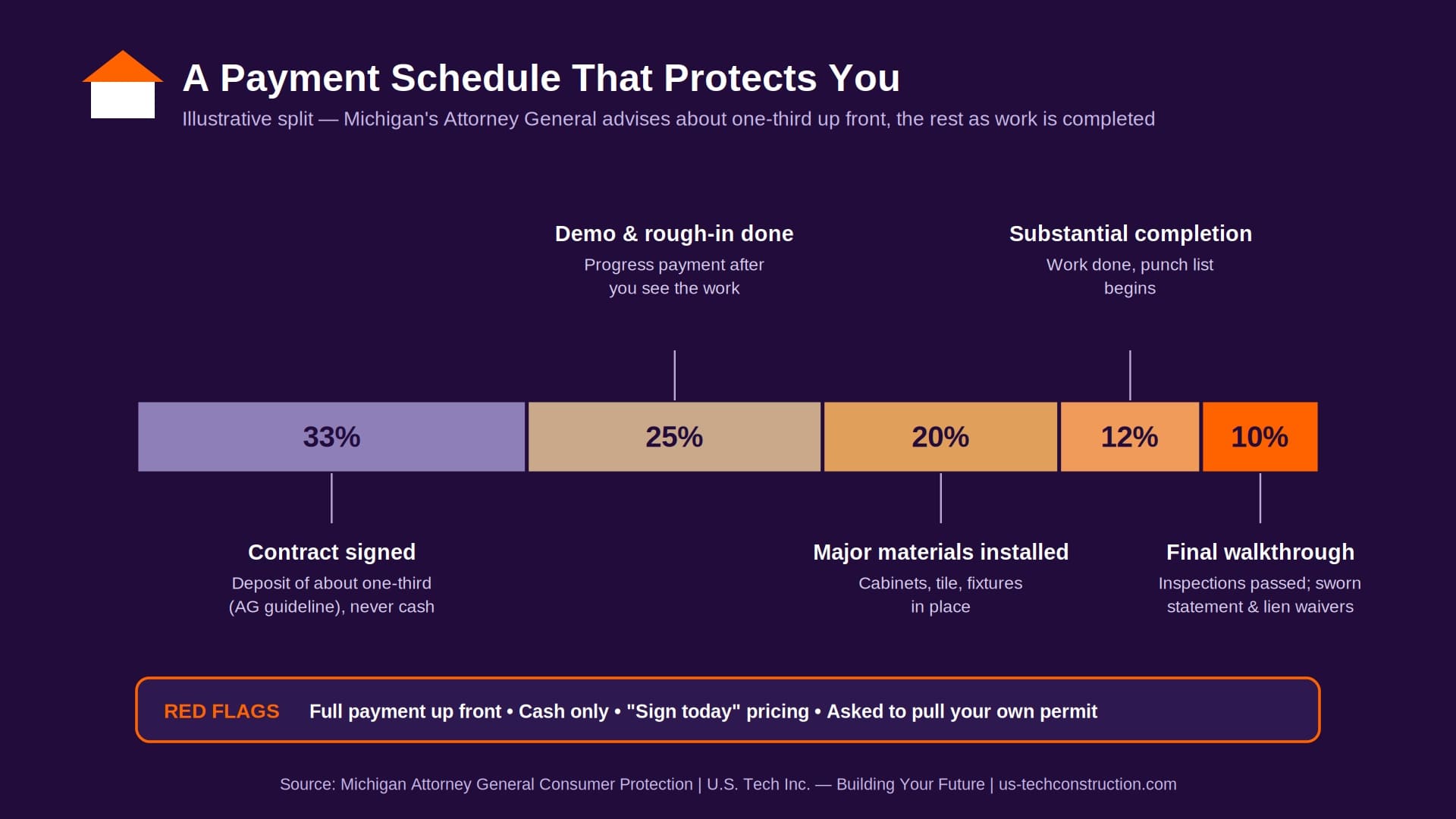
Two quotes with identical totals can carry very different risk depending on when you pay. Michigan’s Attorney General advises against paying in cash or paying in full up front, and suggests that generally one-third of the total contract price is enough as a deposit, with the rest paid as parts of the job are completed and final payment not due until you’ve inspected the work and obtained any required approvals.[10] Paying by credit card is also recommended, since it gives you added dispute protection.
The same guidance says a written contract should include a start and completion date, a requirement that the builder obtain all required permits, a breakdown of costs, the payment dates or events that trigger each payment, and the contractor’s LARA license number, address, and phone number. In certain situations Michigan also gives you a right to cancel, three days for sales solicited at your home and one day for contracts with payments over time.[10]
There’s another layer homeowners rarely hear about until it matters: construction liens. Under Michigan’s Construction Lien Act, unpaid subcontractors and suppliers can place a lien on the property, which is why a contractor’s sworn statement lists every subcontractor, supplier, and laborer the contractor has hired, giving the owner a comprehensive list of potential lien claimants.[12] The Michigan Bar Journal advises that, before making a payment, the owner should always require a sworn statement from the contractor.[13] Ask any contractor you’re considering how they handle sworn statements and lien waivers. This is a question for the contract stage, and it’s worth having an attorney review the paperwork on a large project.
Our guide to permits and regulations for Michigan remodeling and our overview of financing a home remodel in Michigan are useful companions here, especially if a lender will be involved in the payment schedule.
When the Lowest Bid Is Fine, and When It’s a Warning
It would be dishonest to say the cheapest quote is always a trap. Sometimes a lower bid reflects a leaner company, a smaller scope you’re happy with, or simply a contractor who’s between big jobs. The honest answer is that the number alone can’t tell you, and that’s the whole reason to compare line by line.
Still, certain patterns deserve a second look. Be cautious when the scope is a one-line description with no detail, when allowances look unusually low, when exclusions are missing or vague, or when the contractor wants a large deposit or presses you to sign today. The Attorney General’s advice on pressure tactics is blunt: if someone offers a choice of “now or never,” choose never,[10] because legitimate remodeling work won’t vanish in minutes or hours. We’ve written more about the costly side of rushed decisions in home remodeling mistakes that cost Michigan homeowners thousands.
If you’re also weighing a handyman against a full-service contractor for a smaller job, our comparison of handyman versus full-service remodeling contractor explains how scope and licensing change the quote.
Frequently Asked Questions
How many remodeling estimates should I get?
Michigan’s Attorney General suggests two or three written estimates, and Checkbook recommends at least three. More than that rarely helps, and it can burn out the contractors you actually want to work with. The quality of each estimate matters more than the count.
What should a remodeling estimate include?
At minimum, a detailed scope of work, a materials list with allowances spelled out, a list of exclusions, a payment schedule tied to milestones, start and completion dates, and the contractor’s license and insurance information.
Is the lowest remodeling quote always a red flag?
No. But it’s worth checking whether it prices the same scope, uses realistic allowances, and includes permits and cleanup. A low number that holds up line by line can be a real value. One that doesn’t usually grows through change orders.
What’s the difference between an estimate and a quote?
An estimate is generally an approximation that can change as details emerge, while a quote or bid is generally a fixed price for a defined scope. Because contractors use the terms loosely, always ask which one you’re holding and what could change the price.
Bring This Checklist to Every Contractor, Including Us
The best estimate isn’t the lowest or the highest. It’s the one that’s detailed enough to be compared, honest about what it leaves out, and backed by a company you’d trust in your home for weeks. As a family-owned remodeling company in Rochester Hills serving Oakland County since 1992, US Tech Inc. offers clear, no-obligation estimates for kitchens, bathrooms, basements, home additions, decks, and whole-home remodeling. Hold our numbers to the same standard you’d hold anyone else’s. Call (248) 729-2411 or request an estimate to get started.
Sources
- Consumers’ Checkbook: Getting Prices and Proposals for Remodeling Work (Chicago area, updated December 2021)
- Bench: Quote vs. Estimate, What’s the Difference?
- Phoenix Home Remodeling: Remodel Bid vs. Estimate Glossary
- BuildZoom: Comparing and Adjusting Contractor Bids
- BuildZoom: What Contractor Proposals Typically Include
- City of Rochester Hills Building Department: Residential Interior Alteration Permit Application Guide
- NAHB: Home Remodeling Profit Margin Jumps on Demand and Business Practices
- NAHB Eye on Housing: Remodelers Saw Profit Margin Gains in 2024
- Houzz Pro Learn: Renovation Nation, 9 Home Remodeling Trends for 2026
- Michigan Attorney General Consumer Protection: Building and Remodeling, Advice for Homeowners
- Michigan Compiled Laws 339.2403: Residential Builder and Maintenance and Alteration Contractor Licensing
- Justia: Michigan Court of Appeals Opinion on Sworn Statements Under the Construction Lien Act
- Michigan Bar Journal: Construction Liens and the Homeowner Construction Lien Recovery Fund











Leave a Reply