
How Much Does a Kitchen Remodel Cost in Michigan? (2026 Price Guide)
“How much does a kitchen remodel cost?” is the question every homeowner asks first, and the honest answer is that it depends on which kitchen remodel you mean. A refresh that keeps your cabinet boxes and a full gut renovation with a new layout can differ by more than $100,000. Both are called a “kitchen remodel,” and both show up in the averages you’ll read online.

This guide breaks down what kitchen remodeling costs in Michigan in 2026, using real survey and industry data rather than guesses. You’ll see the typical price tiers, where the money goes, what pushes a budget up, a cabinet tariff change that could matter for anyone planning a project, and how to tell whether a remodel pays you back. It’s written for homeowners in Rochester Hills and across Oakland County, but the numbers apply to most of Michigan. Treat everything here as a planning range, not a quote.
The Short Answer: Three Tiers of Kitchen Remodel Cost
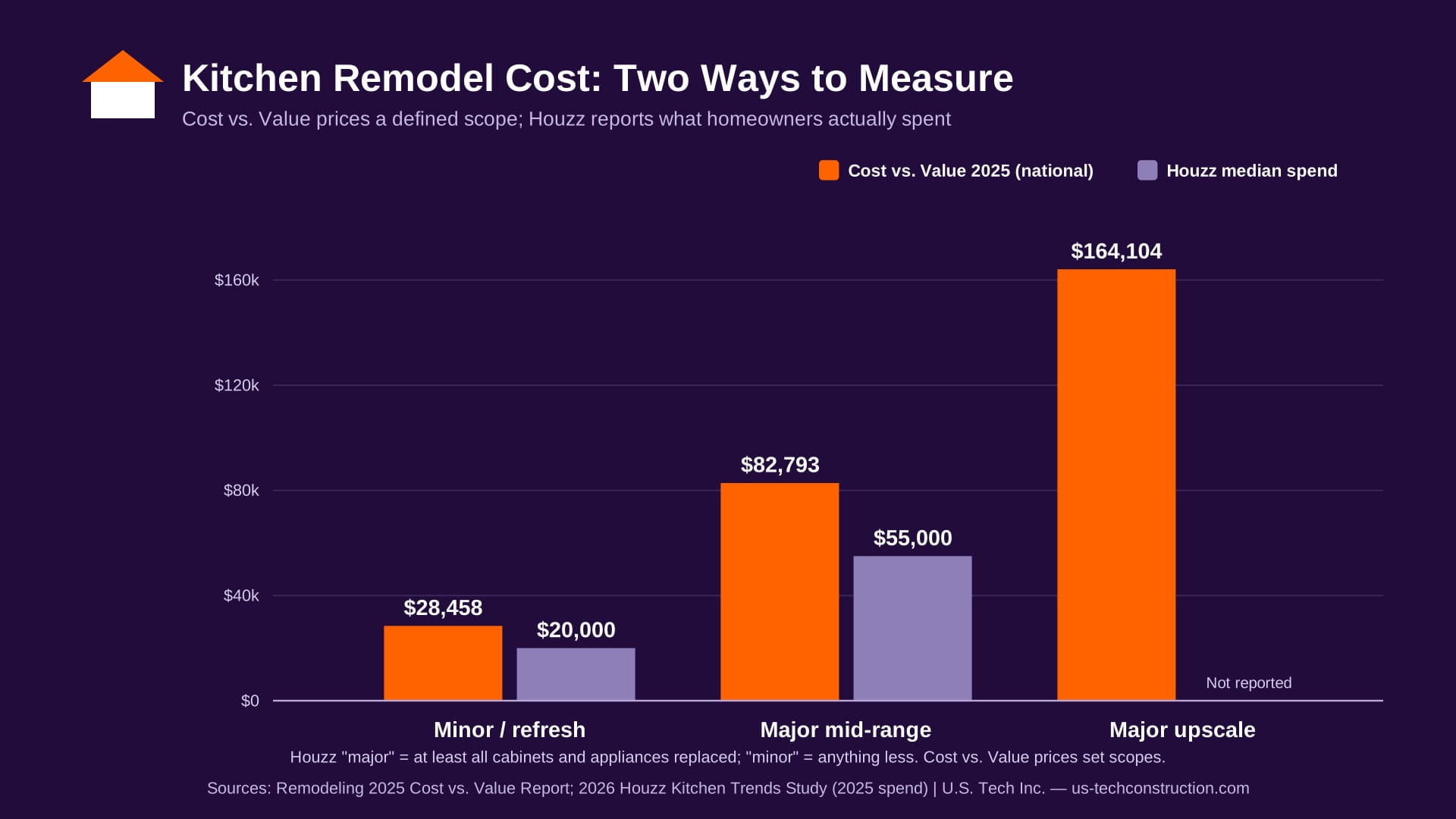
Two respected sources measure kitchen costs in different ways, and it helps to see both. The Remodeling magazine Cost vs. Value Report prices defined scopes of work. For 2025, it put a minor kitchen remodel at $28,458, a major mid-range remodel at $82,793, and a major upscale remodel at $164,104.[1] A minor remodel in that report refinishes the existing cabinets and updates flooring, countertops, and a couple of appliances. In the East North Central region, which includes Michigan, the figures were $27,005 for a minor remodel and $83,113 for a major mid-range project.[2]
The Houzz 2026 Kitchen Trends Study asks homeowners what they actually spent. Its survey of 1,780 homeowners found a median spend of $20,000 for a minor remodel and $55,000 for a major one, where “major” means at least all the cabinets and appliances were replaced.[3] Houzz notes that spending climbs with kitchen size: a major remodel in a kitchen of 250 square feet or more had a median of $75,000, versus $46,000 for a smaller space. The top 10 percent of major remodels reached a median of $150,000.
Why do the two sources disagree? Cost vs. Value prices a standardized, fairly complete scope, while Houzz reports what a wide mix of homeowners spent, including smaller and phased projects. Neither is wrong. Together they suggest a workable frame: a refresh in the $20,000 to $30,000 range, a major remodel somewhere between $50,000 and $85,000 for most homes, and a high-end project that can run well above $150,000.
Where the Money Goes
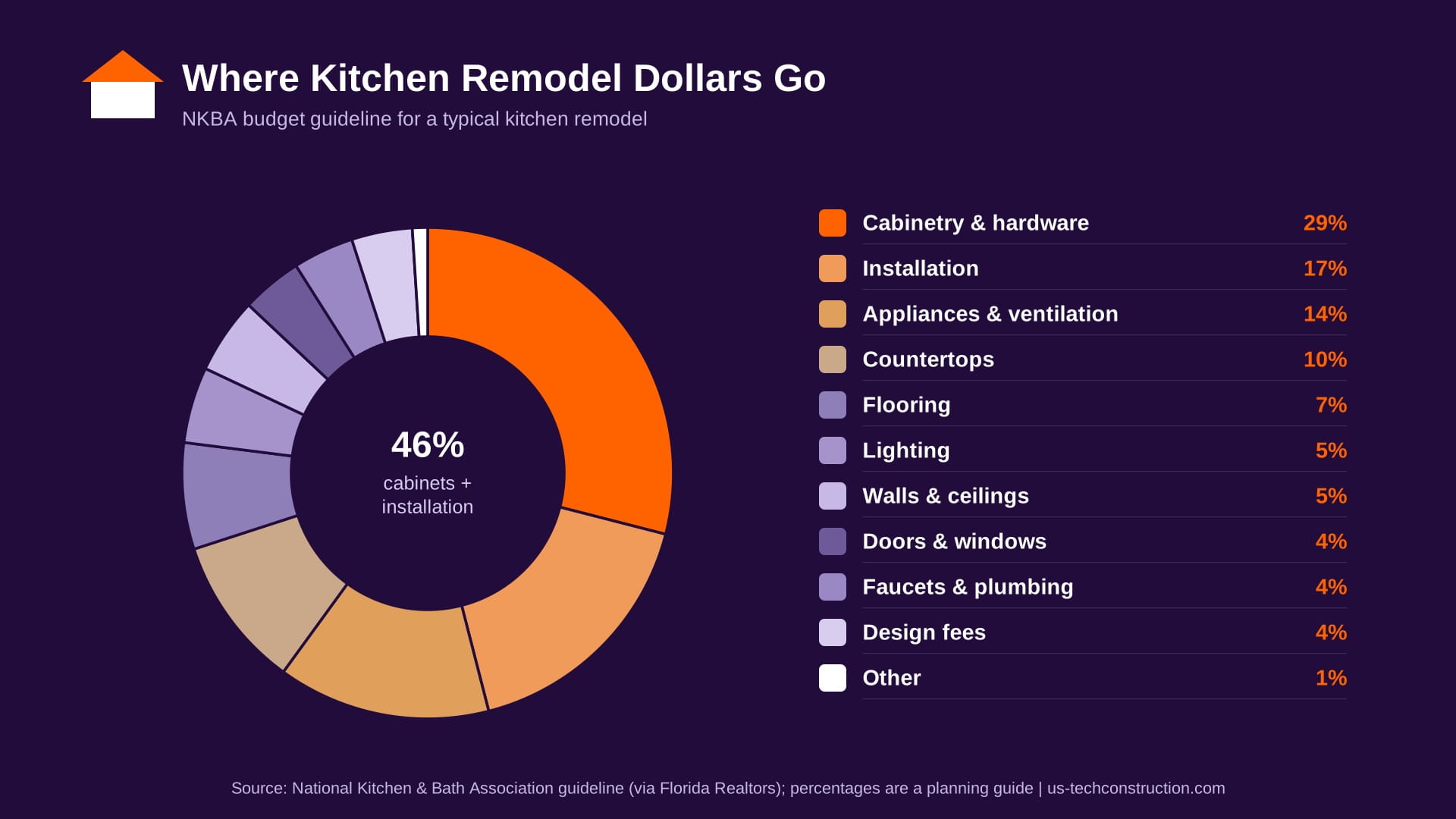
Before you can control a kitchen budget, it helps to know where it lands. The National Kitchen & Bath Association publishes a budget guideline that shows how a typical project is divided. Cabinetry and hardware take 29 percent, installation 17 percent, appliances and ventilation 14 percent, and countertops 10 percent, with flooring, lighting, walls and ceilings, doors and windows, plumbing, and design fees making up the rest.[4] It’s a guideline from a few years ago, so treat the exact percentages loosely, but the pattern holds: cabinets plus the labor to install them are close to half of a typical budget.
To make that concrete, apply the guideline to the Houzz median for a major remodel, $55,000. Roughly $15,950 would go to cabinetry and hardware, $9,350 to installation, $7,700 to appliances and ventilation, and $5,500 to countertops. Flooring would take about $3,850, and lighting about $2,750. That’s an illustration of the percentages, not a quote, but it shows why a $5,000 swing in cabinet choices moves the whole budget more than almost any other decision.
Cabinets are also where homeowners’ choices differ most. In the Houzz study, 68 percent of renovating homeowners replaced all of their cabinets, 27 percent replaced some, and only 5 percent left them alone. Among those choosing cabinetry, 46 percent went custom and 33 percent semicustom, while stock cabinets accounted for just 10 percent.[3] For homeowners who upgraded cabinets only partly, the most common approach, at 50 percent, was refinishing the exteriors rather than replacing them. That path keeps the cabinet budget in check, and it’s the logic behind the “minor remodel” tier above.
What Pushes a Kitchen Remodel Up or Down
Layout changes. The single biggest swing factor is whether the layout moves. Houzz found that 52 percent of renovating homeowners modified their kitchen layout, and 42 percent upgraded home systems such as wiring and plumbing.[3] Relocating a sink, a gas line, or a range means opening floors and walls, which adds labor, permits, and repair work on top of the visible upgrades. Keeping appliances and plumbing where they are is the most reliable way to stay within a tier.
Size and scope. More square footage means more cabinets, counter, and flooring, and the Houzz medians show it. Most kitchens don’t grow, though. About 68 percent stay the same size after renovation, and only 6 percent become significantly larger. If you’re considering borrowing space from a dining room or adding on, that’s a different budget conversation, and our home additions team can help you weigh it.
Finishes and appliances. Houzz found that homeowners upgrade countertops (91 percent), backsplashes (85 percent), sinks (85 percent), faucets (82 percent), and lighting (78 percent) in the vast majority of projects, and just over half replace all of their appliances. Each choice has a good-better-best range, which is why allowances matter so much in bids. We explain how to spot low ones in our guide to comparing remodeling estimates.
Cabinet type. Stock cabinets come in standard sizes and are the least expensive. Semi-custom lines offer more sizes, finishes, and storage options, and fully custom cabinetry is built to your room. Most homeowners choose made-to-order options, with 79 percent going custom or semicustom.[3] The tradeoff is time as well as money: semi-custom cabinets typically take four to eight weeks to arrive, and custom eight to sixteen.[12] If your kitchen has awkward dimensions, a custom or semi-custom layout can solve problems that stock boxes can’t, but it’s worth pricing both before you commit.
Countertops, appliances, and flooring. Houzz found engineered quartz is still the most popular countertop material at 32 percent, followed by granite at 15 percent and quartzite at 10 percent.[3] For flooring, ceramic or porcelain tile and hardwood each landed at 22 percent, with resilient flooring close behind at 21 percent. On the appliance side, gas remains the leading cooktop choice at 48 percent, with induction at 26 percent and electric at 22 percent. Fifty-eight percent of renovating homeowners add or update an island. Each of those choices comes with a wide price range, which is exactly why the allowance in a contractor’s estimate matters. If a quote lists a low allowance for countertops or appliances, your real selections may cost more. Because Michigan winters are hard on floors, our guide to winter-friendly flooring options is worth a look before you choose.
What’s behind the walls. Older homes surprise people. Block Renovation, which analyzes permit data, notes that an aging housing stock frequently surfaces unexpected electrical, plumbing, and structural work that isn’t visible until demolition, and advises building contingency into the budget.[5] Houzz’s broader 2026 study backs that up: 37 percent of renovating homeowners exceeded their planned spend, and among them, 52 percent cited unexpected product or service costs.[6] A common planning rule is to hold back a contingency of 10 to 20 percent.[7]
Permits and fees. Permit costs are small compared with the rest of the budget, but they’re real. In Rochester Hills, residential contractors must register with the Building Department before applying, and the fee schedule lists a $30 contractor registration fee and a $100 non-refundable application fee for residential alterations, with plan review and trade permits on top.[8] Mechanical, electrical, and plumbing permits are applied for online after the building permit is issued.[9] Our guide to Michigan remodeling permits covers what to expect.
The 2027 Cabinet Question: Tariffs and Timing
One factor deserves its own section because it’s time-sensitive. Since October 14, 2025, imported kitchen cabinets and vanities have carried a 25 percent Section 232 tariff, and a scheduled increase to 50 percent was delayed to January 1, 2027.[10] Reporting from October 2026 says the jump to 50 percent is still scheduled to take effect unless a trading partner reaches an agreement that changes its treatment.[11]
Nobody can say for certain what that will do to the price of the cabinets in your kitchen. It depends on where your cabinets are made, how your supplier prices them, and whether trade agreements change the rate before the deadline. But it’s reasonable to ask your contractor three questions: where are the cabinets in this quote manufactured, how long is the price held, and what happens if the cost changes before they ship? Lead times matter too. Published ranges put semi-custom cabinets at roughly four to eight weeks and custom at eight to sixteen,[12] so a decision made in the fall of 2026 and one made in spring 2027 can land on opposite sides of the date. Our post on when to start a remodel in Michigan explains how planning time works.
A Local Check: What Michigan Kitchens Cost
National averages are useful, but Michigan homeowners want a local reference. One data point comes from Block Renovation’s analysis of 479 Detroit kitchen permits filed between 2021 and 2025. The average declared project value was $36,154, compared with a national average of $46,623 and a Michigan statewide average of $54,701 in the same analysis.[5] Block attributes the higher statewide figure to wealthier suburban markets across Oakland, Washtenaw, and Macomb counties.
Two cautions apply. A declared permit value is an estimate submitted when a permit is filed, not a final invoice, and permit data covers only projects that pulled permits. Still, the takeaway is useful for Rochester Hills homeowners: Detroit city numbers likely understate what a suburban Oakland County kitchen will cost, and national numbers don’t tell the whole story either. The best local benchmark is a detailed written estimate from a licensed contractor who has seen your kitchen.
Is It Worth It? Cost vs. Value
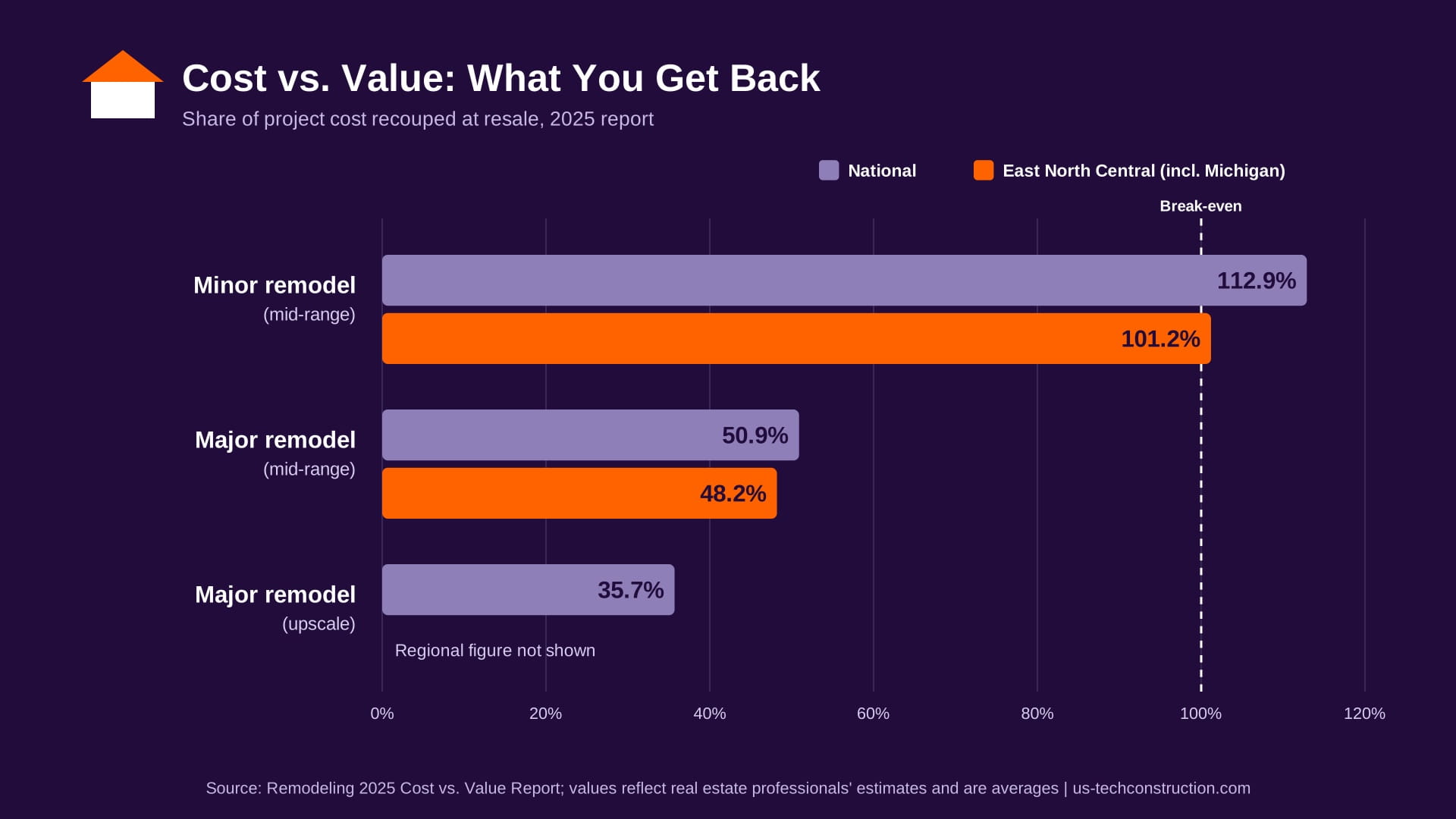
Resale value shouldn’t be the only reason to remodel, but it’s worth knowing. In the 2025 Cost vs. Value Report, a minor mid-range kitchen remodel recouped 113 percent of its cost nationally, ranking fifth overall among the projects studied.[13] The East North Central region came in at 101.2 percent for the minor remodel and 48.2 percent for the major mid-range project, versus 50.9 percent nationally. The upscale major remodel recouped about 35.7 percent.[2]
The pattern is consistent: the more you spend, the smaller the share you get back at sale. Keep in mind that these figures come from real estate professionals’ estimates of added value, and they describe averages, not guarantees for your home. They also don’t capture what Houzz found when it asked homeowners why they renovate. The top triggers were dissatisfaction with the old style (41 percent) and kitchen deterioration or dysfunction (38 percent), while improving resale value was cited by 25 percent.[3] If you plan to stay for years, a kitchen you use every day is its own return. For more on projects that add value, see our guide to what adds the most value during a Michigan home remodel.
How to Budget a Kitchen Remodel Without Getting Burned
Start by choosing a tier honestly. If your cabinet boxes are sound and the layout works, a refresh can deliver a dramatic change for a fraction of a full remodel. If the layout is the problem, or the cabinets are failing, spend where the function is. Then work through a few habits that keep budgets intact.
Get two or three detailed written estimates, and compare them line by line so allowances and exclusions don’t hide the real difference. Hold a contingency for what’s behind the walls. Lock your selections early, since Houzz found that 31 percent of over-budget homeowners attributed it to expanding the project midway.[6] Plan your financing before the deposit is due; our overview of financing a home remodel in Michigan covers the options. And avoid the expensive mistakes we’ve seen homeowners make, summarized in our post on home remodeling mistakes that cost Michigan homeowners thousands.
It also helps to bring in a professional early. Houzz found that 87 percent of renovating homeowners hire at least one pro for a kitchen renovation, and among those spending $50,000 or more, 98 percent do.[3] A contractor can tell you quickly whether a layout idea is a $5,000 change or a $25,000 one.
When estimates arrive, look for itemization. A useful kitchen estimate separates demolition and disposal, cabinets, countertops, plumbing, electrical, flooring, painting, appliances’ installation, permits, and cleanup, and it lists any allowances with dollar amounts. Ask what happens if an allowance is exceeded, how unexpected conditions behind the walls are priced, and who is responsible for pulling permits. Two quotes can look $10,000 apart on the first page and nearly identical once the missing items are added back, which is exactly what we walk through in our guide to comparing estimates. A few minutes of questions now can save thousands later.
Frequently Asked Questions
How much does a kitchen remodel cost in Michigan?
Most projects fall into three tiers. A minor refresh runs roughly $20,000 to $30,000, a major remodel often lands between $50,000 and $85,000, and high-end projects can exceed $150,000. Your final number depends on kitchen size, cabinet type, layout changes, and what’s behind the walls.
Is refacing cabinets cheaper than replacing them?
Usually, yes. Cabinets and their installation are the largest share of a typical budget, so keeping sound boxes and updating the fronts reduces cost. Houzz found that refinishing exteriors was the most common partial approach, chosen by half of homeowners who upgraded cabinets only in part.
Will tariffs raise cabinet prices?
Imported cabinets carry a 25 percent tariff, with an increase to 50 percent scheduled for January 1, 2027 unless trade agreements change it. How much that affects your price depends on where your cabinets are made, so ask your contractor and get price-hold terms in writing.
Do I need a permit for a kitchen remodel in Rochester Hills?
Many kitchen projects do, especially when electrical, plumbing, or structural work is involved. The city requires residential contractors to register and accepts applications online, and its Building Department can confirm what your project needs.
Plan Your Kitchen With a Local Team
A good kitchen budget starts with a conversation about how you actually use the room. As a family-owned remodeling company in Rochester Hills serving Oakland County since 1992, US Tech Inc. helps homeowners plan kitchen remodels of every size, from refreshes to full renovations. Call (248) 729-2411 or request an estimate to talk through your options.
Sources
- NerdWallet: Kitchen Remodeling Costs in 2026 and Ways to Save (citing Hanley Wood Market Intelligence data)
- Journal of Light Construction and Remodeling: 2025 Cost vs. Value Report, East North Central Region and national figures
- Houzz: 2026 U.S. Houzz Kitchen Trends Study
- Florida Realtors: Kitchen Remodel Budget Breakdown (source: National Kitchen & Bath Association)
- Block Renovation: Kitchen Renovation Costs in Detroit, MI (permit data via BuildZoom)
- Houzz Pro Learn: Renovation Nation, 9 Home Remodeling Trends for 2026
- Los Alamos Daily Post: Smart Design With Suzette, Budgeting for a Kitchen Remodel
- City of Rochester Hills Building Department: Building Permit Fee Schedule (effective 12-22-25)
- City of Rochester Hills Building Department: Residential Interior Alteration Permit Application Guide
- Livingston International: Section 232 Duties Delayed on Upholstered Furniture, Kitchen Cabinets and Vanities
- Hashtag Investing: Next Wood Tariff Increase Looms, 50% on Cabinets and Vanities Starting January 1
- QuikCabinets: Kitchen Cabinet Costs in 2026
- Door and Access Systems Manufacturers Association: 2025 Cost vs. Value Report Summary






Leave a Reply